The Future of Advertising Is Not Human or AI. It Is Both.
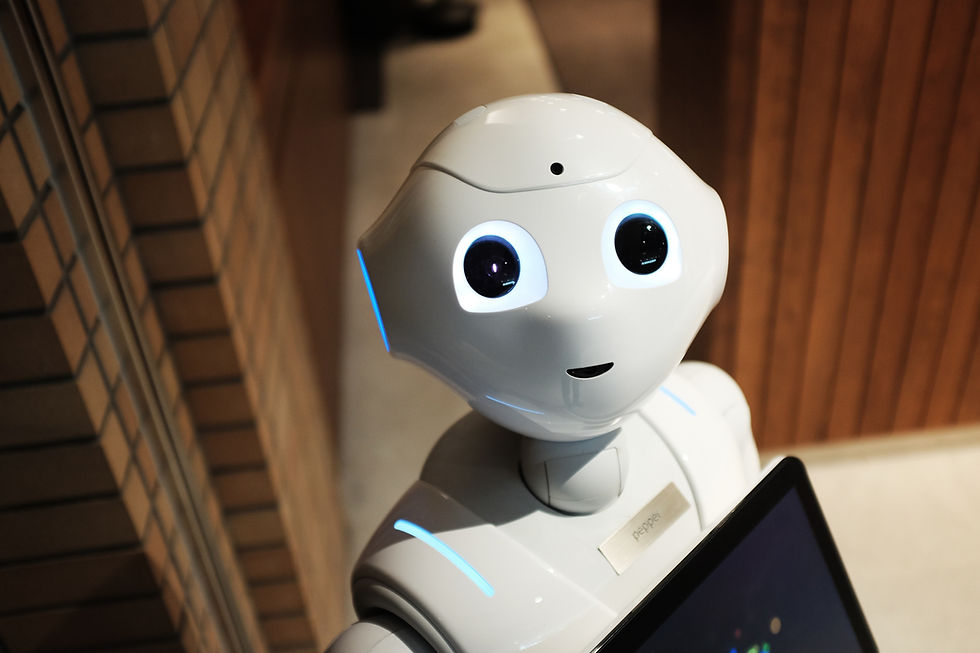
There is a tired debate happening in marketing right now. One side says AI will replace agencies, strategists and creatives. The other clings to instinct and treats every new tool with suspicion. Both are missing the point.
The future of advertising AI is not a contest between humans and machines. It is a partnership. The agencies that win the next decade will be the ones that use AI to do more of what humans are good at, not less.
That is how we think at Barefoot.
What AI is genuinely good at
Let us be honest about the machine's strengths, because they are real and they are significant.
AI processes data at a scale no human team can match. It spots patterns across millions of impressions, tests variations faster than any media buyer, and handles the repetitive work that used to swallow whole afternoons. Gartner predicts that 60 percent of brands will use agentic AI to deliver one-to-one customer interactions by 2028. That is not a fringe forecast. It is the direction the entire industry is moving.
Used well, AI compresses the time between a question and an answer. It frees a strategist from the spreadsheet so they can do the thinking the spreadsheet was meant to inform.
What AI cannot do
Here is what the machine still cannot touch.
It cannot understand why a particular Sydney audience responds to one tone and recoils from another. It cannot read the room in a founder's market. It cannot make the lateral leap that connects an unrelated cultural moment to a brand's offer. It cannot decide which story is worth telling.
As Peter Wallace of GumGum argued in The Drum, AI can pinpoint where attention sits, but only humans can decide how to capture it through messaging and creative that mean something. The data shows you the opening. Judgement decides what to do with it.
There is also a quieter risk. If every agency uses the same AI tools, prompts and templates, the output converges. Everyone's ads start to feel the same. In a world of infinite generated content, the rare thing, the genuine human point of view, becomes the differentiator.
Adobe's own research found that even as marketing leaders pour money into AI, 69 percent plan to increase spending on talent at the same time. They are not replacing people. They are arming them.
The partnership in practice
Harvard Business School professor Karim Lakhani summed up the shift in a line worth remembering: "AI won't replace humans, but humans with AI will replace humans without AI."
That is exactly the bet we make. Here is how it looks day to day.
AI handles the volume: drafting variations, sorting performance data, surfacing the signal in a noisy account. The human handles the meaning: the strategy, the offer, the creative angle, the read on context and nuance that turns a competent campaign into one that actually moves people.
The data tells us what is happening. The human works out why, and what to do next. Strip either half away and the work suffers. Run them together and you get speed without losing the soul of the work.
Why this matters for your business
If you are choosing who to trust with your marketing budget, this is the question that matters. Not whether they use AI, and not whether they avoid it. The question is whether they use it to think better or to think less.
An agency that hides behind AI to cut corners will give you generic work at scale. An agency that refuses to touch it will be slow and expensive. The one you want sits in the middle: leveraging the machine for everything it does well, and bringing real human judgement to everything it does not.
That is the standard we hold ourselves to. We use the best tools available, and we never let them do the thinking that should be ours.
Frequently asked questions
Will AI replace marketing agencies? No. AI will replace agencies that only ever did mechanical work. The strategy, creative judgement and contextual understanding that good agencies provide are exactly the things AI cannot do on its own.
Is AI-generated advertising effective? It is effective for speed, scale and testing. It is weak on originality and nuance. The strongest campaigns pair AI efficiency with human creative direction.
How should a business use AI in its marketing? Use it to remove repetitive work and to process data faster, then invest the time you save into strategy, offer and creative. Treat it as an amplifier, not a replacement.
Talk it through
We built Barefoot on the belief that fundamentals matter and judgement cannot be automated.
If you want a marketing partner that leverages the best of AI without losing the human thinking behind it, book a free strategy call.


Comments